The Emerging Workflow
When I started Percept Index at the start of last year, 2025, I primarily focused on writing. Get thoughts, concepts, ideas, and experiences captured quickly and explore them deeply. As experiences evolved and grew in significance and interest, a call to manifest them further beyond words was felt very strongly. I began to stretch and develop my illustration muscles. It’s been a long time since I’ve recommitted to that type of creative work. Truth is, for me, writing and illustration have dominated my life from first memories to today.
You’re probably wondering, “What in the heck are his first memories that relate to writing and illustration?” Well, I’ve revealed the 1st grade memory that ignited my love for writing in a full-feature journal entry last year. I’m afraid the first memory regarding illustration will have to wait a bit longer. I was very young. It was innocent, but also a little too much for this time in Percept Index’s own existence to dive into all that. I promise that it’s good, funny even. Just be patient please. It’ll come out eventually.
When it comes to writing, my style is pretty much set and done. To be honest with you, I’m not even that good of a writer to spot, track, modify, and purposefully evolve my “style.” I don’t really even know what it is. Conversational? When it comes to illustration, however, that is something I’ve always been able to control. I want to be clear: there is an overarching “style” or “tone” that all of my work over the years has. It is my unconscious signature, so to speak. I could probably describe it. I know that it exists, but I wouldn’t be good at that. Things like this are best revealed through the eyes and minds of the audience.
The illustration direction at any given time in my life does change. Like anyone, I can get bored doing the same thing over and over. Also, not every style fits the context. So after a year of starting up and eventually getting into a rhythm of weekly illustrations, I’ve come to a desire to further expand my creative consciousness by searching and exploring for a new illustration style and direction. The goal isn’t to throw out everything I do now but rather focus on what I want my visual voice to be, what I want to keep going back to week after week. I’ve got tools and techniques. That’s fine. But maybe there’s another somewhere in there. Maybe there’s a new wrinkle I haven’t explored but perhaps pondered about in the past.
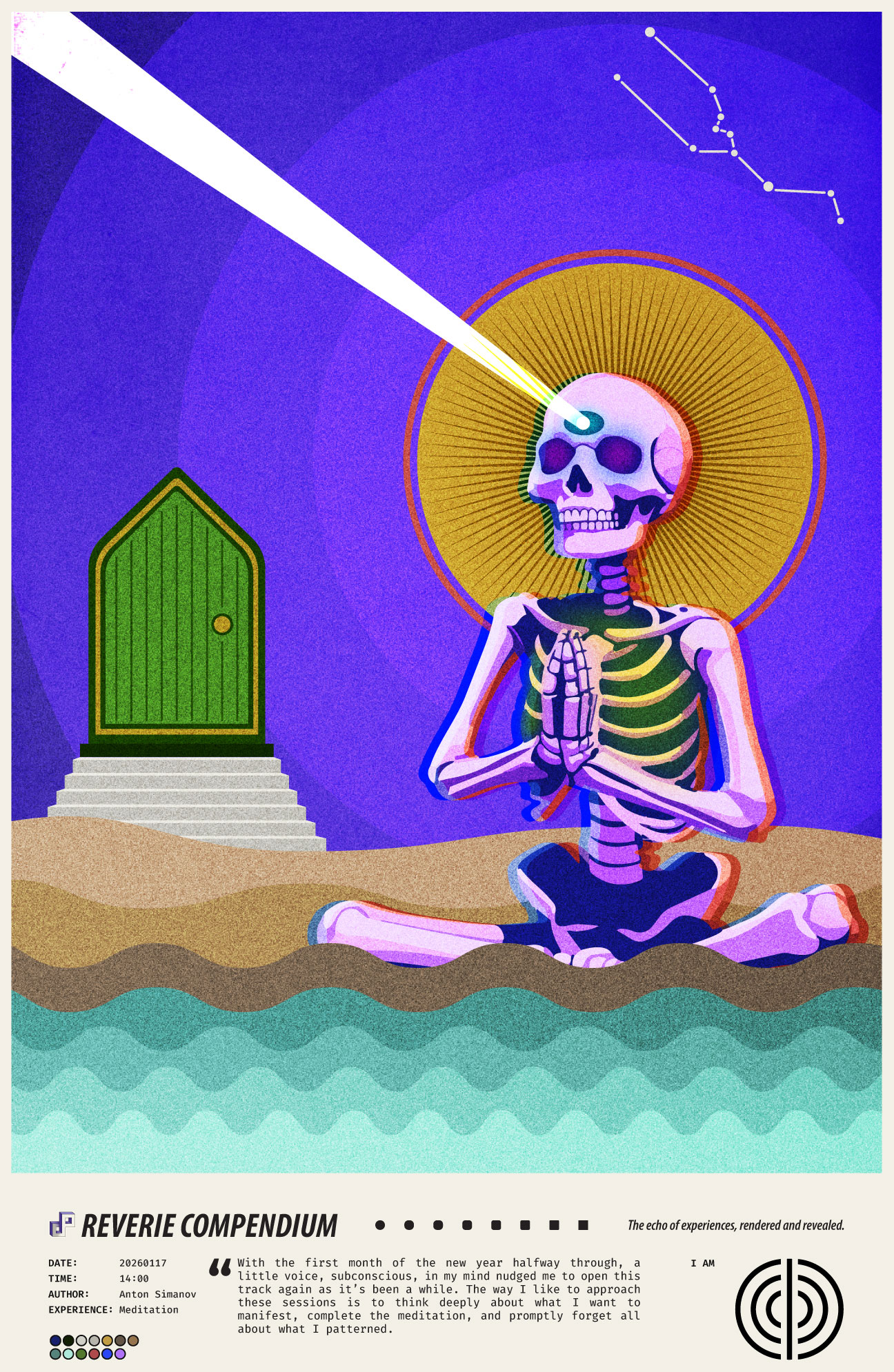
Pious Bones
With this week’s illustration, I took an unexpected step into this process. It’s been on my mind and I’ve experimented here and there, but this was seemingly on a whim and it quickly started to scale in my mind.
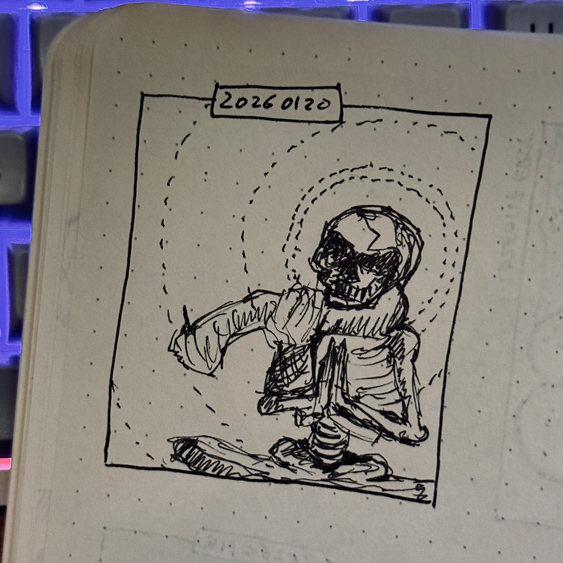
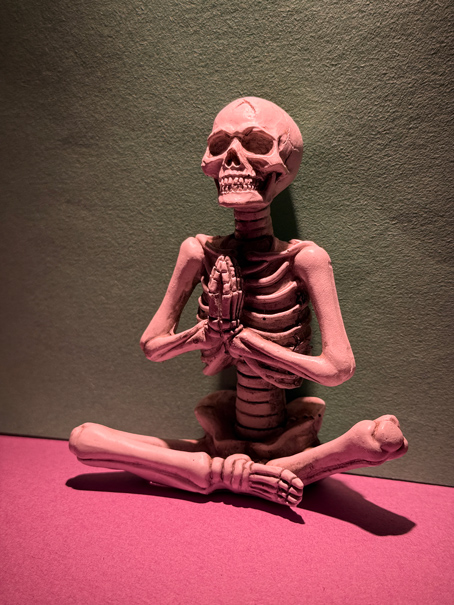
I was sketching a skeleton sitting in meditation/prayer. I then remembered that we have a figurine just like that somewhere around the house. I finally found it in the garage. Poor guy broke his back (ouch). Nevertheless, nothing a supporting wall and careful balancing can’t fix for a moment or two.
I carefully placed the pious skeleton on the bench in my office. Under and behind it, I placed two pieces of construction paper. The bench by itself is white, so is the skeleton, so I needed solid color and flat floor and backdrop. Snapped a few shots and took it to Adobe Illustrator.
An aside: By the way, we always wrote “AI” when referring to Adobe Illustrator, and while I’m not shattered at the fact that “AI” means something different now, it is a bit annoying.
In Adobe Illustrator, I image traced one of the photos. I don’t normally like to image trace. I am experimenting, however, so I have to deal with it. Because I planned this to begin with, it didn’t take long to clean up the resulting trace. After that and isolating the skeleton from the floor and backdrop, I traced it again to get a cleaner and more uniform, or simpler, vector out of it.
Next came the phase I like to call: back on my bullshit. I say this lovingly and directed at myself, obviously. Last year I was after finding the right texture that I wanted to treat all of my illustrations with. My M43 camera does lovely photos with noise treatment, so I experimented with generating textures from various shots. I settled on what I like to refer to as “paper-like,” which gives vector lines a kind of marker feel to them.
The vector elements themselves remain as well. I gravitate toward simplified shapes and structures. This constraint allows for more deliberate thought and planning. The end result is a paper-like cutout structure. Last year that became the main theme of the illustrations, and this year I’m continuing it forward but adding a more hands-on approach by photographing specific subjects and objects to nail down the main composition and then using that exact image as basis for the illustration.
I’ve also updated the format. I kept the “Reverie Compendium” information below the main piece but changed all the data to display in a single monochromatic color palette. The only break from that is the placement of color swatches at the bottom left corner. It remains largely unchanged from the prior year. The main image itself has been extended to 4:3 ratio in profile/vertical orientation (so I guess 3:4).
It is for this reason that the workflow is evolving into construction of a dedicated light box rig. I’m not really sure if that’s the right name for this rig, but essentially it’ll be a 2 to 3 sided 24” box with an open top. Think of isometric images. This is the format/ratio I’m going for. The rig also allows for, essentially, unlimited lighting possibilities. I have plans for more complicated compositions using this method in the future, but first I must build my “staging” area in the only way I know how to: do shit first, add and upgrade as the need arises.
In general, I’ve found that constraints are a necessary catalyst for creative work. I used to think that my seemingly stubborn obsession to turn everything into a framework with rules and regulations was just my personal mental illness, but I do not view it that way anymore. When your work relies on open-ended variables, it takes a long time to develop. When you add constraints and rules, you are forcing your creative muscle to actually work. It doesn’t mean that these rules never change. Of course they do. They evolve right alongside your creative process.
Lastly, I will absolutely still employ my other illustration styles as the subject calls for it.
If you’ve read this far, I wholeheartedly thank you. In the coming months, a few things will be taking up my creative time away from experimenting with this process, but I have strong intentions to manifest this workflow and rig into physical and waking life.