When I turn, it turns with me.
Who am I? What am I? What is all this?
Something’s been bothering me. Not enough to cause a serious deep dive but always there, like an ever-present hum somewhere in the background that I haven’t resolved yet. It originates from within, and yet it’s like a nebulous cloud that I know is right behind me — when I turn, it turns with me, obscuring my sight of it. That something began a few years ago, a year or less before Percept Index unofficially launched.
We have the capacity to understand that this something didn’t just emerge out of the aether as recently as my early 30s. It’s been with me since I can remember. It’s my curiosity, my wonder, my wounds. It’s that constant feeling that something larger than all this is just around the corner. It’s the longingness I feel when I ask, “Who am I? What am I? What is all this?”
What happened a few years ago was very innocent and consistent with so many others. I was feeling lost, who doesn’t? As I sat in my backyard staring at the evening sky, I quietly cried to myself, pleading with whatever and whoever to help direct me into what I was supposed to do. It’s a hopeless juxtaposition to feel the need to create, to pursue your purpose, and yet to feel absolutely lost in the middle of this expansive fabric of reality. I felt small, insignificant, and yet still that nagging thought at the back of my head was pinging to tell me that I’d forgotten to show up to some important event.
I honestly believe that the dreams we often have of missing significant events that we should have remembered (like the midterm) and rushing to rectify the situation are misalignment calling: You’re not on the right track, you’re forgetting something, wake up! Easier said than done, but what’s even more paralyzing is staring at the problem, knowing it’s a problem, and doing nothing about it because you have no idea where to begin or what that even looks like.
My desperation was heard, and I felt the pull to begin documenting altered states and experiences with various tools for consciousness exploration. The first few months, I wrote to myself, in no way was I in shape or ready to share any of it. Little by little I began to send some of it here and there, primarily to my closest contacts. Eventually I stood up a website for Percept Index and let it just collect the written work.
Then I remembered something from years back when I really wanted to dive into my old work again as an illustrator. The problem was that any good and solid visual work is preceded by good and solid writing. I wasn’t ready to seek trivial work here and there, my art was for me but it lacked substance and I knew it. With Percept Index I had realized the writing foundation for the visual work that I longed to be engaged in.
First came the Reverie Compendium collection of digital work, predominantly vector-based and entirely constructed in Adobe Illustrator. It’s the last comfort blanket that I reached for from my university years. I loved being “whole ass” in creative work again, in fact way more than I’ve ever been, with writing steering and guiding as a compass. Yet, still, something wasn’t quite right (is anything ever?).
From 2025 and into the early part of 2026, Reverie Compendium grew to 25 entries. First I produced whatever I could from the comfort level that I had at the time. Then came exploration either into fields I’ve not touched in years or into brand-new ventures (M43 photography-inspired compositions, for example). As I sat there looking at the entire collection, I couldn’t help but continue to return to pieces that were built from sketches. Their uniqueness comes from the translation of my visual language from hand to paper, even if it’s rusty from underutilization for all these years.
I saw an opportunity in front of me: Shift to hand-drawn, colored, and inked illustration on a small surface to retrain the mind-to-hand connection and speed up the process overall. Thus Field Notes, which were already being explored in written form, became the center stage for this direction and process. The chief constraint for Field Notes is that they have to be written and illustrated in the same day, there’s a hard cut-off time at the end of each day that determines how far the illustrations can go and once that cut-off is reached, whatever is done, is done.
An aside: When I was 8 years old, I began to attend the Catherine Palace Art Academy. That sounds fancy, but the reality was that the classrooms were tucked away in the “peasant quarters” of the vast imperial property and had no heat, no insulation, and a barely functioning water supply. What it did have that was invaluable were the beautiful and vast grounds to draw inspiration from, incredible and empathetic instructors, and one pissed-off art director who (I’m pretty sure) hated children. As I began the Field Notes schedule, I was thrust back into one of my core memories from that art academy: sitting for hours in front of an easel, non-dominant hand forced to be at your side (or sitting on it), dominant hand engaged in drawing vertical and horizontal lines as “accurately” and without flaws as possible… meanwhile the art director, who ran this entry-level course, would periodically pop in the classroom and loudly berate the young students for their shoddy work while puffing on his very strong tobacco pipe. I never had my paper ripped from the easel like other students, but I did feel the burning sensation of tobacco sparks stinging the back of my neck and exposed arms. As I and my classmates moved on from this entry course into the rest of the program, our numbers dwindled from 12 to 6, and eventually 5. Good times!
Percept Index is my longest project, ever. It hasn’t looked the same from the first iteration to now, and that is something I’m actually quite proud of. Instead of abandoning it like many ventures before it, I periodically reassess and then I pivot, I change something, I keep moving forward. Would I want this all to move along faster and arrive where I’d like to be? Of course, but therein lies the boulder in my path: What does arrival look like? What is “there”? Just what the hell do I want from all of this?
Right, here we are with a persistent and continuing project, good. Now, where is it all going? What is the “what” driving my intention, not the “how”?
What is my work.
I write, I illustrate. My work has two faces like Janus. Janus represents transitions, thresholds, and passages. He allows for simultaneous sight in opposite directions, symbolizing beginnings and endings. I write about what happens at the edge of a threshold, when you cross it, and what’s on the other side of it. I illustrate a representation, idea, thought, symbolism that is birthed from that passage — the perception of what it was and what it means to me after.
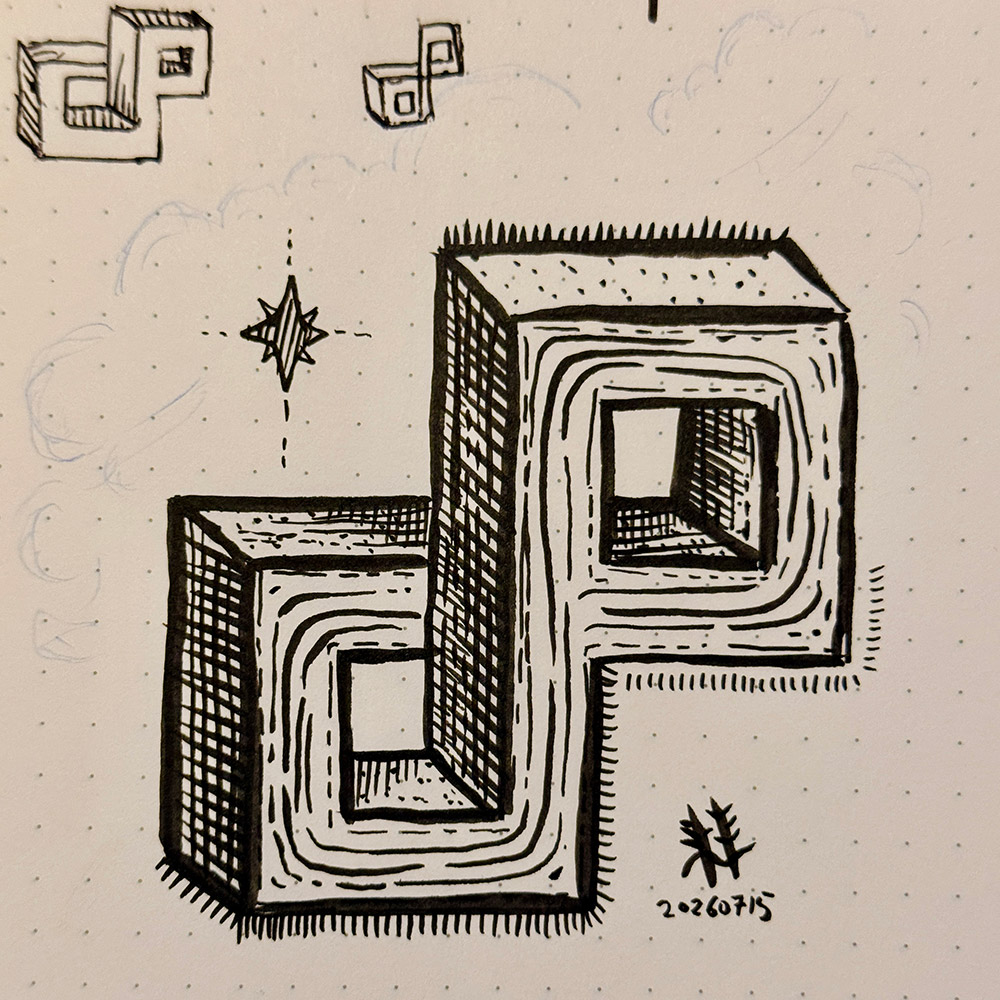
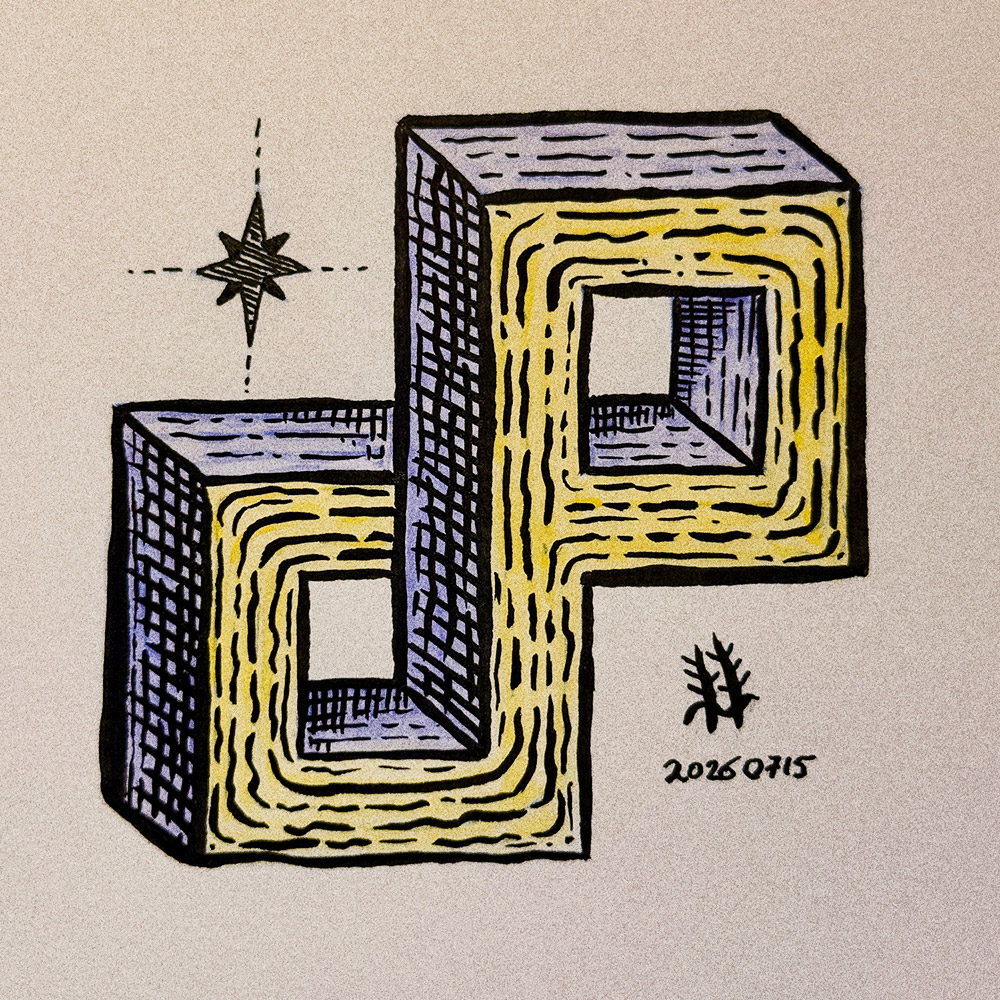
The Percept Index logo itself symbolizes this duality. Simple impossible geometry, ouroboros when stretched and redrawn, and the original geometry sports halves like faces of Janus. A beginning and an end.
What I want from Percept Index.
Dialogue. I want my work, as cliché as it sounds, to inspire a thought, a question, a start to a dialogue. What do I love to talk about? What do I not shut up about given an inch to talk about it? Consciousness, the human condition, altered states, mechanics of it all. I write often about transmuting collective unconsciousness into collective consciousness, in my position I have the tools to help the cause one reader at a time. Even the faintest spark of curiosity or wonder will ignite a flurry of activity from within. Like a seed lying dormant before the conditions are right, sometimes those conditions are imposed and other times they happen by chance. I want my work to be that chance, to push just a little bit or a lot, much like it happened to me.
Ultimately, just like every artist before me, with me, and after me, here I am proclaiming my mission: my work seeks to find out who I am becoming, what I am becoming, and where we are all going.