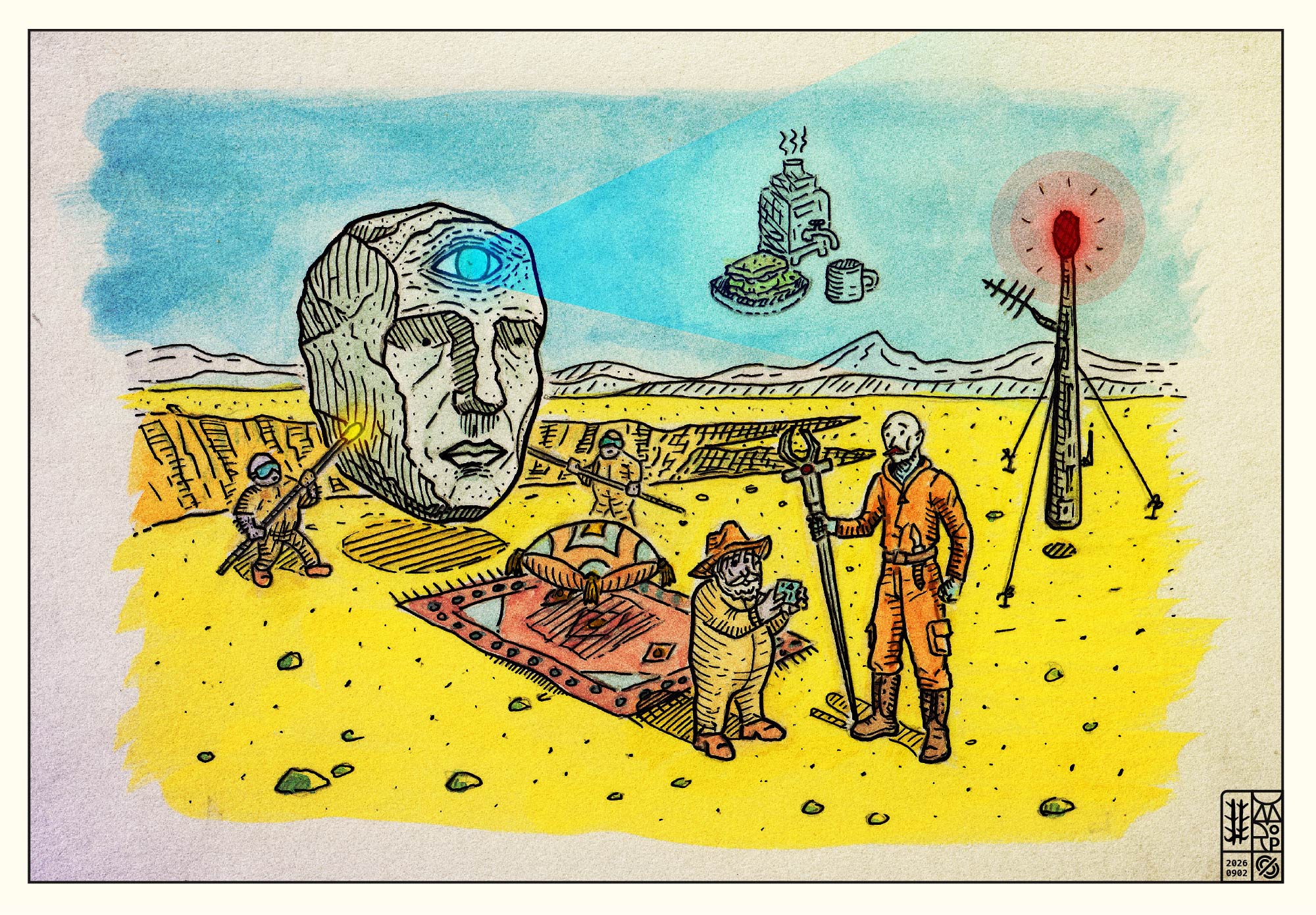
I just kept dying.
Field Notes of Rahgah - 20260902-S3
A byproduct of intact memory across lifetimes is the freed-up bandwidth of awareness to think and imagine unimpeded.
Let me open this cycle with an admission: I have very little interest in past lives, mine or anyone else’s.
This tends to surprise people. In the circles where my work travels, past lives are a standing fascination. Regressions, akashic records — I get asked about that one constantly. “Have you gone? You should go!” Like it’s a day trip to a library. Every time the subject comes up, I run into the same thing: a block. It’s not negative, there’s no fear or avoidance, more like something quietly whispering, “None of it is important.”
For a while I performed interest; it seemed it should be something to be interested in. I told myself the sensible-sounding line: how will you ever know where you’re going if you don’t know where you came from? Logically that makes perfect sense, but when the total being responds to a logical statement with “hmm meh,” logic isn’t what matters. I consumed pieces of the regression literature and never finished any of it. I did the self-hypnosis tracks. The barrier never dissolved, and eventually I just accepted it.
Recently I stumbled into the Seth material — channeled through Jane Roberts starting in the 1960s — by way of some repackaged commentary of dubious transparency. That’s a separate lesson: I’m going to the primary text, and I’d recommend the same to anyone. The theme that caught me is genuinely Seth’s, and it shows up in the Law of One as well. The forgetting is not damage, it is design, you chose to forget.
The veil isn’t something inflicted on the incoming soul; it’s something the soul does, deliberately, because experiencing a life with the answers printed in the margins isn’t living — instead it’s a show you passively watch.
If we all choose the forgetting, then the severity of each person’s amnesia is chosen too. My veil is thickest exactly here, over the past-lives channel, and I no longer think that’s accidental.
Here’s the evidence I’d offer, and it comes from character, not from any vision or reading. Every romantic relationship I’ve ever had moved in one direction. When it ended, it ended — I’ve never been friends with an ex-partner. It never made sense to me to step backward off a forward trajectory and settle for some lesser arrangement.
I tried to adjust this about myself, more than once, because our culture insists staying friends is the mature thing. I failed spectacularly each time. That’s not a policy I hold; policies can be revised. This aspect was there before I had reasons for it.
Now apply that same orientation one level up. A past life is a concluded relationship with a previous self. The connection ends, the yield stays, the archive grows. I don’t go back: the same character that won’t reverse out of a relationship won’t reverse out of an incarnation.
If the forgetting is chosen, the cleanest way to build a veil isn’t with a thicker door but with an occupant who doesn’t reach for the handle at all. My disinterest is the veil implemented as disposition.
My framework says the same thing from another angle. A past life, delivered as narrative, is a story about an experience — an experience that had been had by an instrument I don’t stand in now. The experience that would turn it into knowledge isn’t available to me anymore. Attention parked on past lives is parked permanently at belief, and belief is the one stage never meant as a resting place. Meanwhile, what actually crosses the seal doesn’t arrive as story at all, it arrives as structure.
My kids made this obvious. The oldest boy arrived careful: quiet, watchful, slow to talk, and fiercely competitive practically from the crib. The youngest walked in loud: owns every room he enters, friendly with everyone, very physical, and occasionally produces curse words nobody around him uses, like he’s been saying them for decades. They share confidence and creativity, but each came in with characteristics that were one hundred percent not learned nor mimicked.
There’s another side to this, and here I’ll use a stronger word than disinterest: aversion. Listen to how people usually describe their past lives. There’s no shortage of samurai, knights, warriors, priestesses, wealth. Always something neat, something shiny, something that compliments the current ego doing the telling.
In all my time around this material I have never once heard, “In my past life I was a chimney sweep.” Never “Most of my lives I was a poor serf.” Never “I just kept dying young.”
Currently our best guess is that over a hundred billion humans have lived on this planet. The overwhelming majority were subsistence farmers and laborers, and for most of history somewhere between a third and half of everyone born died in childhood.
An honest sample of past lives would be crushingly repetitive: planted, harvested, buried children, died of infection at thirty-five.
Did it all again and again. The modal past life is too short and too anonymous to even make a unique story. So when the visible reports cluster around samurai and temple priestesses, you don’t need to evaluate any single account.
It’s a double filter. The retrieval flatters, the publication selects. Even Dolores Cannon acknowledged that most regressions turned up ordinary, tedious lives, and the interesting ones made it into the books. What reaches your feed has survived two rounds of glamour selection.
That’s ego-flattery pointed backward in time; it’s the same product as “you’re one of the awakened ones,” just wearing plot armor. What legitimately crosses the seal arrives as operation without story: disposition, orientation, the way you move before you have reasons. The glamour report is the movie, a story without operation, a costume that changes nothing about how anyone actually lives. One of them does work every day of my life, somebody’s samurai does no work at all.
These past few years I remembered more of who I am than I’d ever been able to claim truthfully before, and none of it came from a regression.
It came through shadow work: experience, in this life, on this instrument, leaving knowledge behind, retrieved when needed.
Whatever else I brought in already came through, in the only format that survives the crossing: how I do things, how I react (or don’t), how I live.