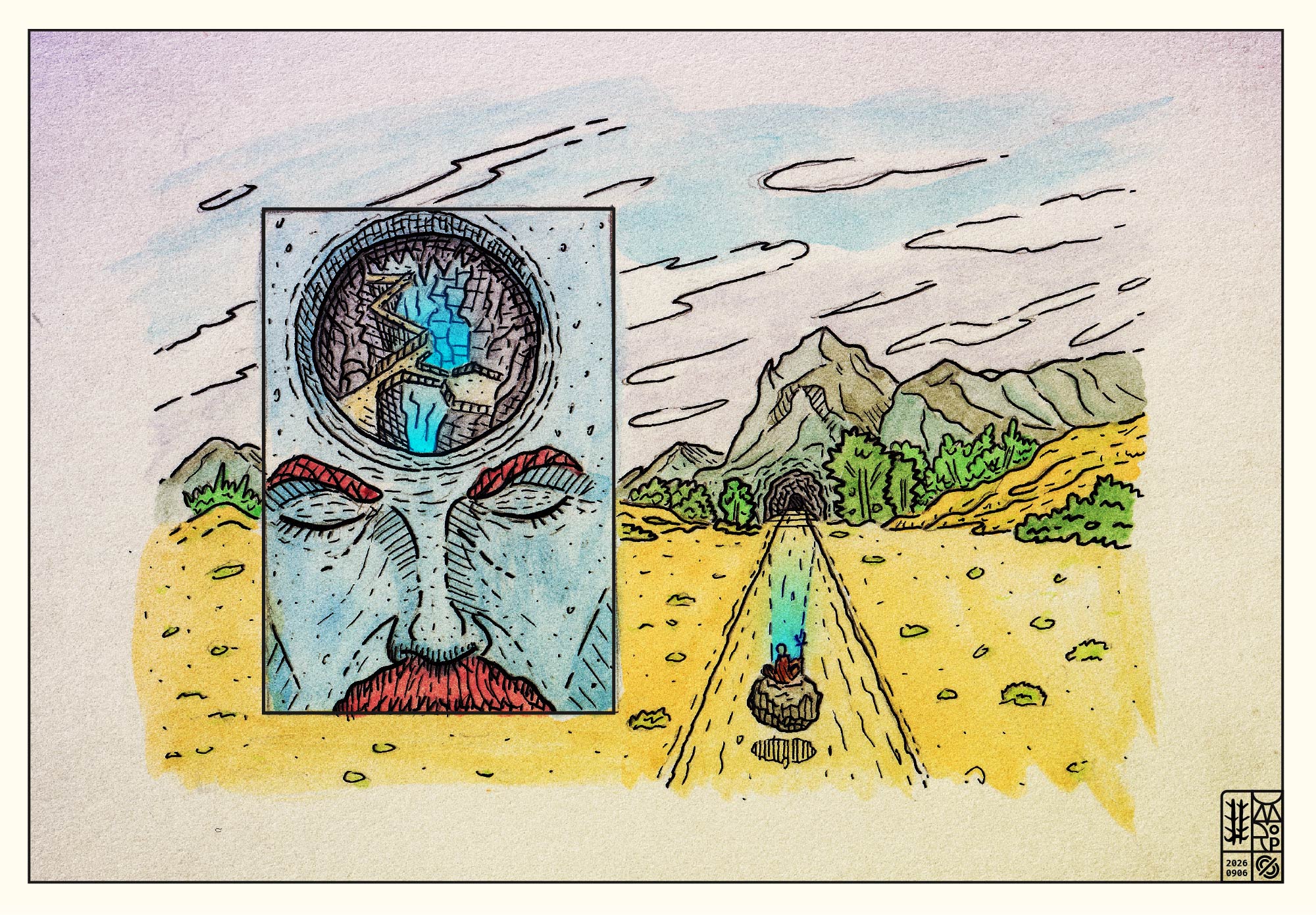
More serious than you can imagine.
Field Notes of Rahgah - 20260906-S3
Use imagination as destination and arrive.
One of the biggest blocks in my practice was wrapping my head around the fact that imagination is commonly used to bootstrap altered states. Growing up, I noticed how imagination, the word, was used by adults, and it left me puzzled as the things they said seemed to contradict one another.
On one hand, I would be praised for my wild imagination; on the other hand, imagination in general would be dismissed as frivolous. Then I would be lectured on how important visualization is (which is imagination), but not as important as hard science… I studied masters of old who were revered for being visionaries of their time while I was also being discouraged from pursuing a creative career.
There are many other examples, and I don’t need to list them all; I’m sure you’ve experienced some of that yourself. So, over time, in our Western society the word “imagination” became unserious, not as useful as other more serious (seemingly) activities, and something to encourage in children but to be quickly discarded for serious work in adulthood.
In actuality, imagination is serious, much more serious than you can imagine (heh). Quite often I will hear someone explain that it’s difficult for them to do The Gateway Tapes, manifesting work, or another guided meditation because they’re “not good at imagining” or not “very imaginative”.
Sure, some people are better at this task like some people are better at sports than others; talent definitely touches this human aspect as well. Having said that, everyone has a capacity for this kind of task and, more importantly, can train it, improving their floor.
Let’s take manifesting, living in the wish fulfilled, as an example. When this task is described as difficult, one of the things I like to suggest is to move your cognition away from “seeing” what you want to manifest and instead focus on how it feels when you already have it. How does it feel to wake up in your new house? How does it feel to walk on the tile your new house has? How are the mornings in this place — do they feel calm and cozy? How about the evenings? Quiet and peaceful?
There are many ways to imagine a situation that don’t require seeing it. You have other senses; they too participate in imaginal activities. In fact, I’d argue that senses aside from sight are more important.
What makes you think that someone is talented in creative fields? Is it that they’re better able to visualize something and faithfully replicate it on a 2D surface? Or is it that they’re able to inhabit a scene with most or all of their senses on command, thus delivering a more realistic visual than just something to look at?
It’s the inhabiting. The rendering is craft, learnable by anyone with patience and reps. What feels like talent is the scene arriving whole: the weight of things, the temperature of the light, the sound the floor makes. Get that, and the visual takes care of itself, because you’re not making a picture anymore, you’re reporting from somewhere.
Here’s the evidence that the picture was never the point. Some people have no mind’s eye at all; the condition is called aphantasia: they close their eyes and get nothing, a dark screen. By the “not good at imagining” logic, they should be locked out of creative work entirely. The co-founder of Pixar has aphantasia. So does the Disney animator who drew Ariel. Careers at the summit of visual imagination, run without pictures. Whatever the faculty is, it survives losing its most famous sense, which means it was never made of that sense.
Meanwhile, the serious world uses imagination constantly; it just launders the name first. Visualization. Mental rehearsal. Simulation. Athletes run mental reps, and the gains show up on the field; in one well-known study, people who only imagined contracting a muscle for weeks got measurably stronger, no movement involved.
Mental piano practice reshapes the same motor cortex real practice does. Surgeons rehearse procedures in their heads; rehab clinics prescribe imagery to stroke patients. When money and outcomes are on the line, nobody calls it child’s play, they rename it and bill for it.
That study result shouldn’t surprise anyone who read yesterday’s entry. The body petitions upward in pictures, and it accepts instruction downward the same way. Imagery is not decoration on top of the real work, it is the protocol the deeper layers function on.
This is why the floor is trainable. If your screen is dark, don’t start with the screen. Start with narration, plain words: the tile is cool, the house is quiet, the morning is mine. Language is the easiest way in, and the senses follow it the way they follow a good book. Do it daily, and the scenes thicken on their own, the same way conditioning works, because it is conditioning.
The block I opened with dissolved the day I stopped hearing “imagination” the way adults used it and started treating it as an instrument. Build the destination out of feeling, step in, and the arriving handles itself.