Nothing leaves a body that has not agreed to be left.
Field Notes of Rahgah - 20260916-S5
Study what puts an instrument at rest. Nothing leaves a body that has not agreed to be left.
Last cycle ended with the dive pointed at whatever I am. This one opens a layer below that, at the thing the dive leaves behind. I’ve been calling parts of this work easy or difficult; neither explains what I’m qualifying well beyond subjectivity. A better word, or criterion, is “natural”. Whether a given process is something this physical body takes to, or something it tolerates for a while and then refuses. More importantly, the instrument isn’t without preferences that I wish to respect.
If you’ve been interested in astral projection, the instructions on how to achieve such a state aren’t hard to find. The methods and techniques are plentiful, different, and readily available if you look. Roll out, climb the rope, sink through the floor, intent is everything, lucid dream first and then launch into astral projection, etc.
They all read like a very specific manual for someone else’s body. If this body responds poorly to being rolled out of, the technique will fail, and on the rare occasion it works, it won’t hold. The instructions are fine; most of the time they’re more than adequate without a second explanation. The real side-quest is finding out which technique is natural for your physical instrument, the body and mind.
Here’s the model. I’m ticklish, there are situations I can’t be calm in, and someone who isn’t ticklish breezes through those same situations without a thought. Neither of us is doing it wrong. This body is also nervous in small spaces and at real heights. When I’m projecting, none of that applies. Awareness has no such limits, which means the limits belong to the vehicle, and they came with it.
So the goal for the deep work is to retune itself. I’m no longer focusing on “how do I get out” or “what other ways are there to get out”; the goal becomes “what puts this body at ease fast and secure, the way it expects, so that awareness can disengage and go about its business.”
Different goal, different orientation, and it is discoverable because the body has been reporting its preferences for years. According to my chart, the tie between awareness and this vehicle runs unusually strong. Someone with a looser tie might skip this step; I don’t have that option.
I already know I’ve had success in a number of ways and failures with specific techniques. So, the “getting out” isn’t a question that needs answering; that’s been confirmed many times. Instead of attempting everything under the sun and cataloging it, I’m refocusing on the ideal state itself.
The body doesn’t object to rolling out. It objects to being handled. And the way an exit snaps shut, attention landing back on the physical body from close range, is the same reflex from the other side. The body sees the hand coming and tenses up.
This is how I’ve always worked anyway. I seek the form appropriate for my concept, learn it by reproducing it, adjust, remix, repeat. It’s how I draw and paint, and it turns out it’s how I do this. The body is examined the same way a still life is observed: what it actually does, not what I wish it did.
Last week I wrote that the way to know a thing is to go to its origin and bring back the name, and that I’d been running that operation on everything except the operator. The operator’s vehicle needs it too. What calms it, what it guards against, what it tolerates, and under which conditions it lets go… reliably.
I’ve been down this road for about a year without calling it anything. This is me putting words and rough structure around it, which is what I do with everything eventually.
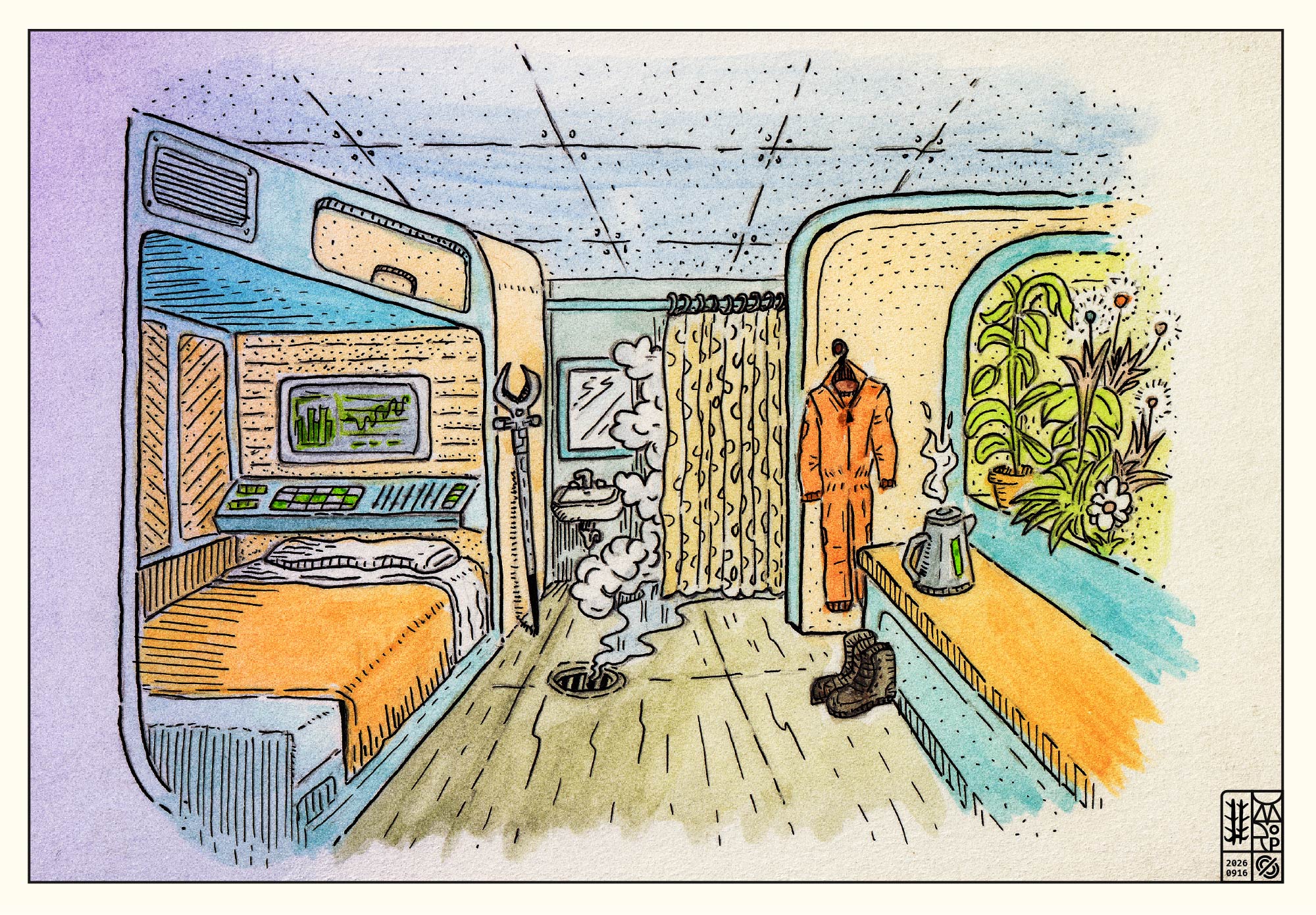
The suit is hanging up, the boots are off, and whatever is behind the curtain is finally getting taken care of (our hero is just taking a shower after a long trip, get your head out of the gutter, you weirdo).