Started verbal, ending imaginal.
Field Notes of Nobody’s Ghost - 20261021-S10
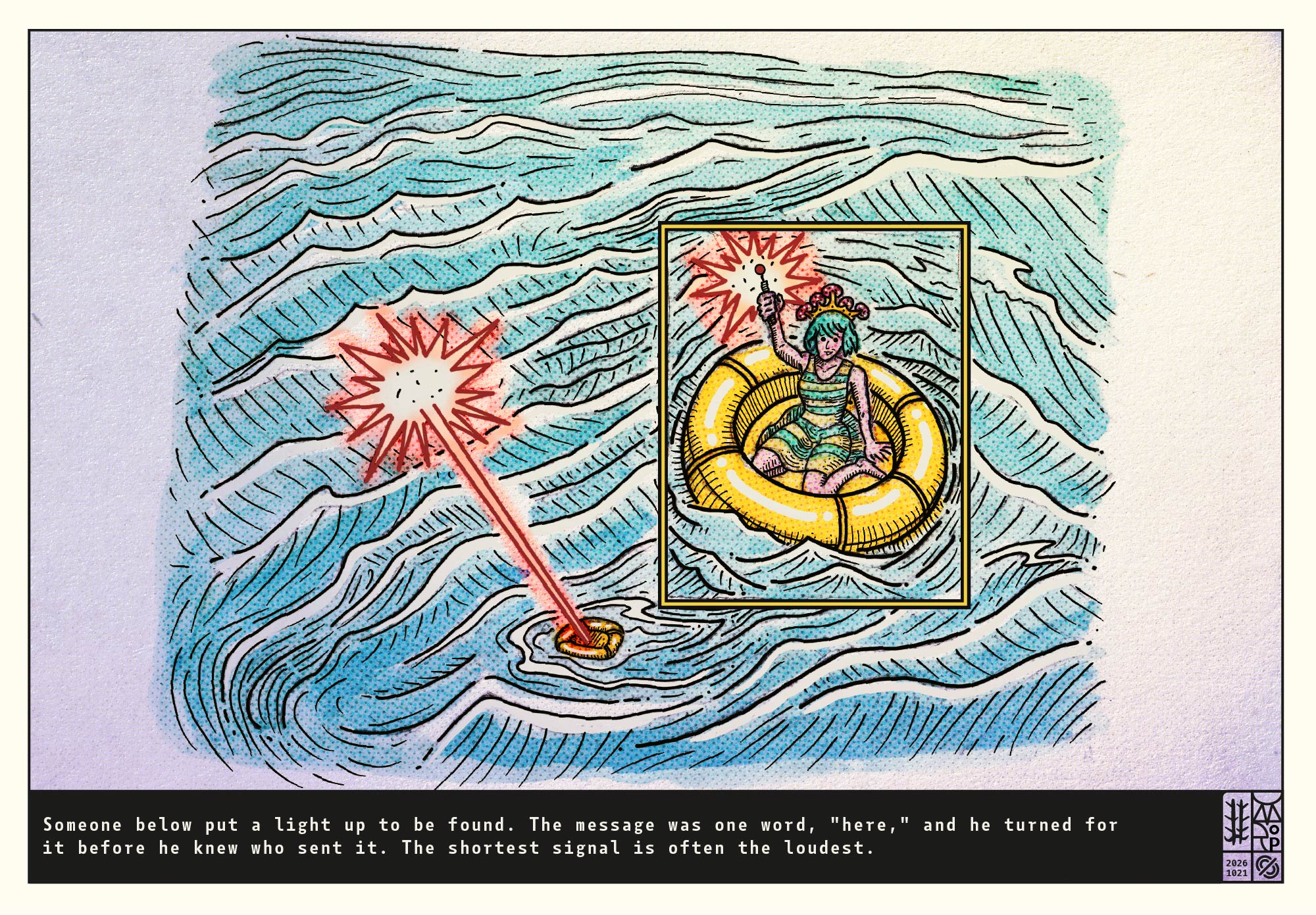
Someone below put a light up to be found. The message was one word, “here,” and he turned for it before he knew who sent it. The shortest signal is often the loudest.
I hope that this time our ghost doesn’t get hoodwinked into something he didn’t intend to sign up for. Though, unlike the previous encounter, he isn’t trying to assimilate but reactively responding to a signal from someone in need.
Something lighter to kick off this week. A thought I had while remembering a Reddit thread that was making fun of all of this, and which I assumed was wrong. Well, it was funny nonetheless.
The thought: millennial slang is mostly acronyms, Gen Z slang is mostly symbols. That’s the whole thought. I checked it, and it’s half right. The half I had is the interesting one, clearly since I got it right, because the mechanism underneath it is the input device.
Millennial slang was typed under constraints. T9 keypads, 160-character texts, AIM, early Twitter at 140. Compression is the name of the game, so you get LOL, BRB, OMG, TTYL, FOMO, and a symbolic layer of emoticons built out of punctuation, because punctuation was what the keyboard had. Then LOL drifted. It stopped meaning laughter and turned into a tone marker, which is what every generation ends up adjusting with its most-used word.
Gen Z typed on an emoji keyboard and learned from video. So yes, symbolic, and the symbols get reassigned instead of read literally: the skull 💀 for “I’m dead,” a cap 🧢 for a lie, sparkles ✨ for sarcasm. The spoken half is borrowed, heavily from AAVE and ballroom culture, and from gaming. Some of the symbol use is forced on them, substitutions built to slip past moderation filters, “unalive” and the corn 🌽 emoji. They still use acronyms constantly, lowercase, and as tone rather than compression.
Gen Alpha goes one step past symbolic. Skibidi, rizz, gyat, sigma, Ohio. These words mean nothing except “I’ve seen the video.” The better word for it is referential: the token points at a piece of shared content, and if you haven’t seen the content, the token is noise.
Line the three up and it’s one progression with three steps. A compressed phrase, then a picture with an assigned meaning, then a pointer at something everyone has already seen. Keypad, emoji keyboard, feed. Each cohort talks as a reflection of the content consumed, created, and used within a short window of technological progress.
I have a rule in this practice for getting an intention past the controller, the part of me that wants to manage the how, and into the subconscious, where it actually gets done: begin verbal, end imaginal. Bootstrap it with words, because words carry feeling easily, then let it turn into an image, naturally leaving the words behind. I had that rule down as my own, but it turns out that the culture performed it at scale, over about three decades, with nobody deciding to. Started verbal, ending imaginal.
Make of that what you want. I’m not going to make anything of it this week. That’s it, that’s the entry.