The Other Moon.
Field Notes from 20261107: A speculation on Locale 1 and what Ingo Swann saw
This one is a speculation. It is built from the accounts of others and from my own record, and I hold it as speculation, with absolutely no claim to be right.
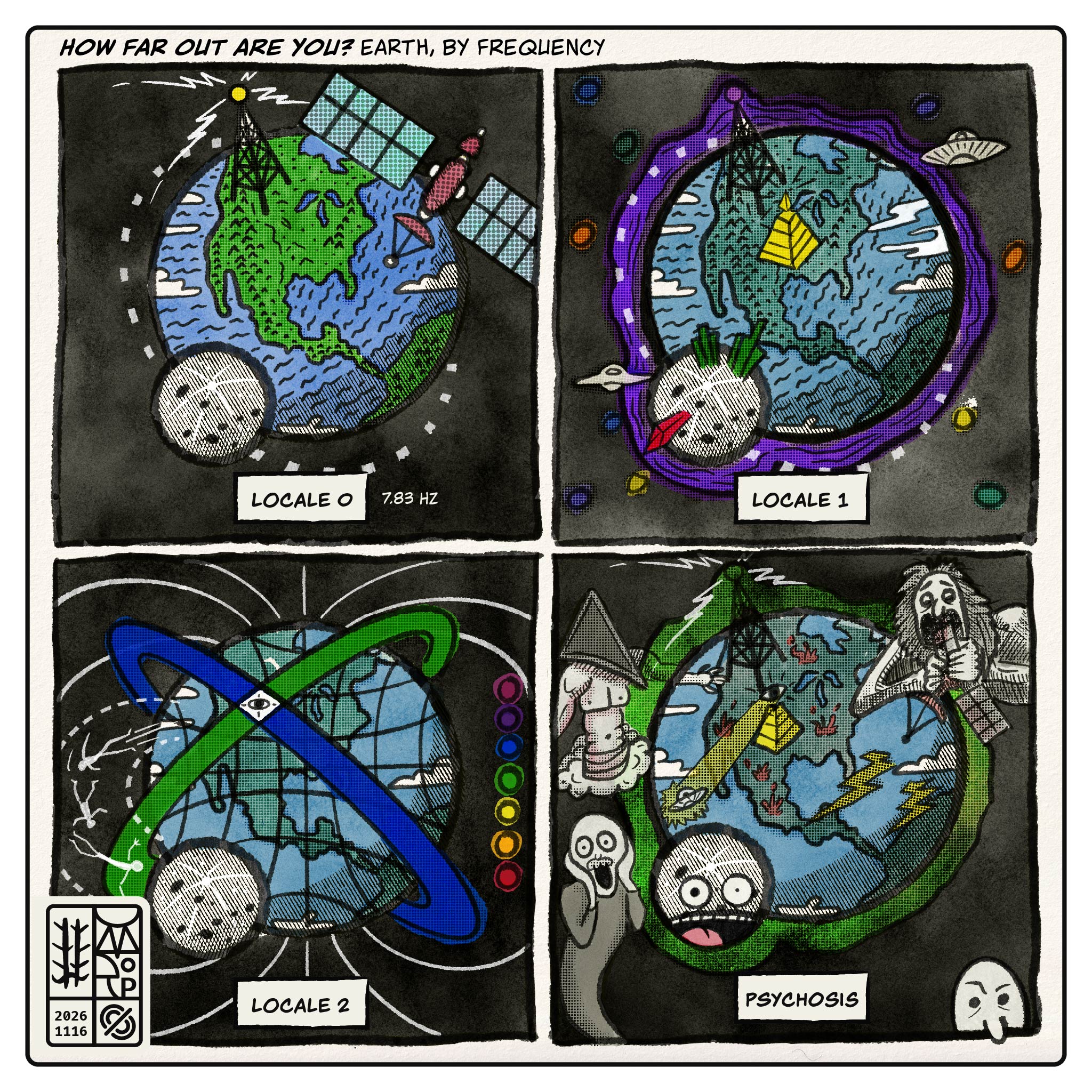
Robert Monroe sorted the places he went out of body into locales. His Locale I is the Here-Now: the people and places of the physical world, visited in the second body. That numbering annoyed me at first, because the physical should be the first locale. With a Locale 0 inserted, it actually makes sense. Locale 0 is the physical Earth frequency. Locale 1 is the etheric, the energy Earth frequency. Locale 2 is the catch-all for every frequency further along the band from Earth. The numbers count distance from the physical frequency band rather than height above it.
Or, you know, it’s all happening at once. Frequency does not describe distance. There is no travel involved, just frequency and vibration. Think of it like software that renders the environment: it’s all one system, something emanates from something else, and that something else has further higher-level processes influencing it, and so on. No wonder a stacking order has been used to describe reality, and why it looks like higher and lower. Those words describe what is; lower does not necessarily mean “bad” and higher should not always mean “better.”
An aside: Robert Monroe (1915-1995) was an American radio broadcasting executive who wrote three books on his own out-of-body experiences, starting with Journeys Out of the Body in 1971. He founded The Monroe Institute, whose audio training I use.
The speculation: Locale 1 is populated, ordered and of interest. The published reading starts with Monroe and says there isn’t much there. His Locale I holds no strange beings, events or places, and when one showed up, he suspected his own perception. By the 1970s he wrote that going out had become boring: everyone was asleep and there was little to gain from visiting them.
Start with difficulty. Monroe wrote that travel in Locale I is far from easy and that the second body is not at home there. My experience agrees, and so does the experience of others I know: entries are brief and the state has a tendency to snap shut quickly. Why a puzzle or a barrier at the door of a room with nothing important in it?
Then there are the guarded places. Too many reports, in the literature of the remote-viewing pioneers and in current accounts, describe physical locations protected and guarded in the non-physical by state-affiliated actors. That is no different in kind from the spells and wards recorded in older sources, true or not. The frequency closest to the physical one has the most impact on the physical, and that includes remote viewers, the first-person kind of viewing some now-famous operators describe.
An aside: Remote viewing, a term coined by the artist Ingo Swann, is the practice of describing a distant or hidden target by mind alone. The U.S. government funded it from 1972 to 1995, first as research at the Stanford Research Institute and then in an Army unit at Fort Meade known at its end as Star Gate.
Finally, Ingo Swann’s moon. In Penetration, published in 1998, Swann wrote that in 1975 he was asked to view the far side of the Moon and saw structures there that no human built. I hold that the account is true but misunderstood. I suspect what he viewed was the Locale 1 moon. The Locale 0 moon is the one the cameras see, and that is why the orbiters and the two landers China has put on the far side find dust and rock. The Locale 1 moon is a different story, just like any other Locale 1 version of physical Locale 0 locations.
Swann does not stand alone on the record. Paul H. Smith, who served in the Army’s remote-viewing unit and was trained by Swann, has said on Coast to Coast AM that he was tasked with the Moon on a project with Swann, and that the two of them made similar sketches of underground artificial structures. Lyn Buchanan, another veteran of the unit, says he viewed bases on the far side himself. Hal Puthoff, who worked with Swann at SRI, says he has no reason to dismiss the account. Russell Targ, on the other hand, doubts it was written as nonfiction.
Rahgah, the world of Field Notes of Nobody’s Ghost, was built on this very shape before I thought any of this out loud: a sparse physical surface whose inhabitants have greater abilities than ours, levitation, thinking rocks, and a vibrant Locale 1 above it, a whole floating city over the ocean, with rules and order. Keeping the ghost in Locale 1 also explains why the landscape held steady after he went through the portal from his room and again through the tree. Locale 1 is built one to one off a physical with unique-to-Locale 1 additions.
My own Locale 1 expeditions behave the same way. The rooms of my house render one to one, and then it holds what the physical does not: a shape in the bed on Kim’s side while she was at work as an example, which pushed back when I shoved it.
From this position, the idea that we are the product, our physical bodies and our lives, starts sounding far less underhanded and menacing. The only true evil is obscuring knowledge of it all to hide the actions of others. Lying.
In my model this whole space is speculation, built up slowly by accounts into belief, and into knowledge as experiences arrive. This one sits at belief, as there is still much room for experience to crystallize into knowledge.